
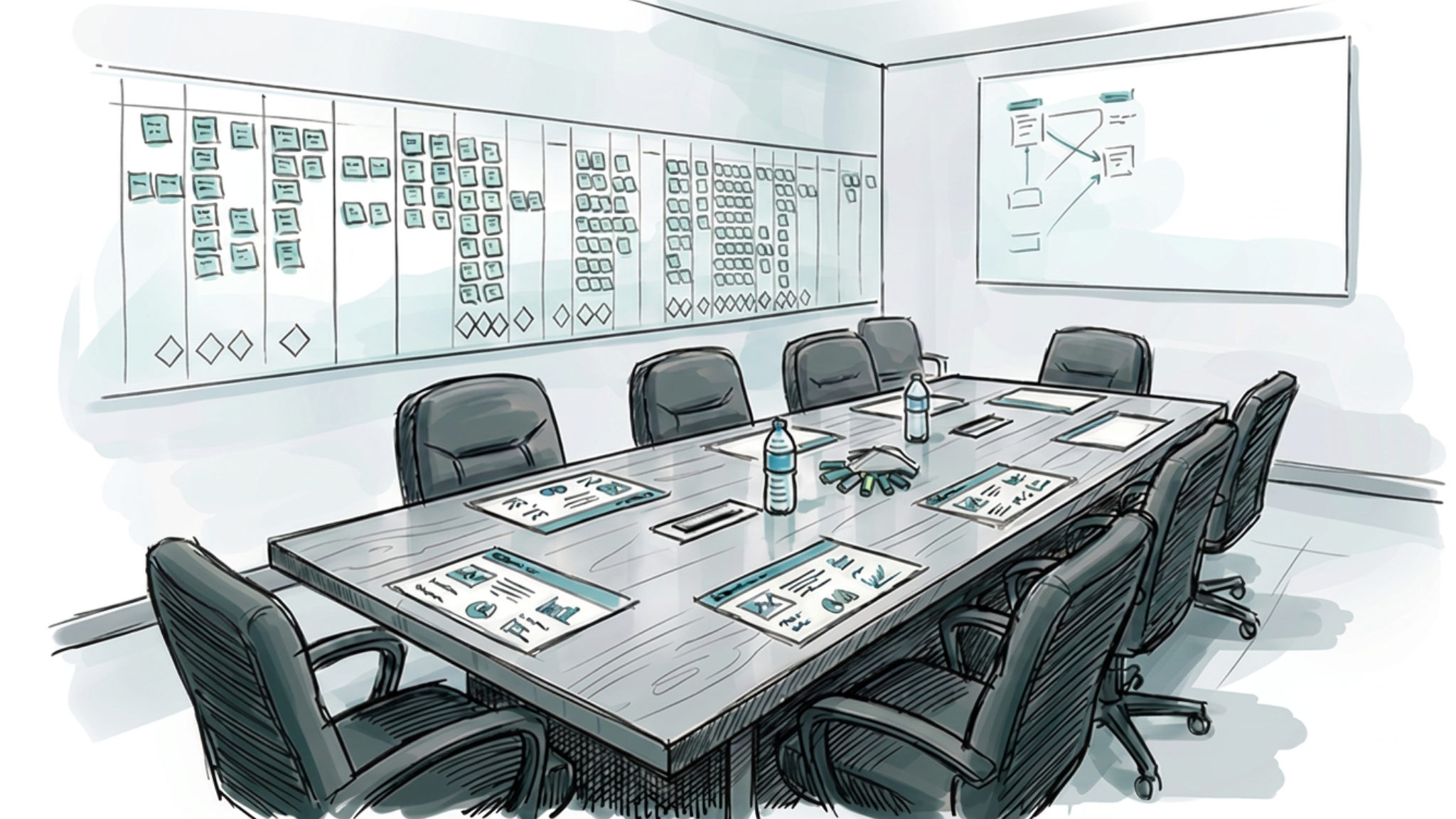
We Set Up the Briefing Room
The moment we arrive on site, we take the largest available space and turn it into project intelligence HQ.
Monitors. Drawings on walls. Data flows mapped and visible. Every role (scheduler, cost analyst, safety coordinator, materials, document control) operating from the same room, pulling from the same intelligence.
This isn’t a war room for show. It’s a live system. Anyone on the project who needs to know what’s happening walks through that door and gets a real answer. No chasing emails. No waiting on updates. No version confusion.
The Briefing Room is the nerve center. Everything connects through it.
We Run Boots on the Ground Exercises
We don’t build the plan from the top down. We build it from the work up.
We bring the people actually doing the work into the room (foremen, leads, trades) and we look at the drawings together. We ask how long things will take. We challenge assumptions. We teach the planning fallacy: the proven human tendency to underestimate time, complexity, and what can go wrong.
Then we teach commitment-based methodology. Not what someone hopes to finish. Not what looks good on a Gantt chart. What they can actually commit to and stand behind.
The result is a field team that owns their plan and a schedule grounded in reality.
The Whole Project Tightens
When the Briefing Room is running and the field team is planning against real commitments, something shifts across the entire project.
Data flows clean. Decisions get made faster. The gap between what’s happening in the field and what leadership thinks is happening closes. Teams stop operating in silos and start operating as a system.
We’ve run this process on projects exceeding $20 billion with more than 5,000 people at peak. We’ve run it on lean efforts where four people needed to move like forty. The methodology doesn’t change. The scale just grows with it.
This is what project intelligence looks like in practice.